
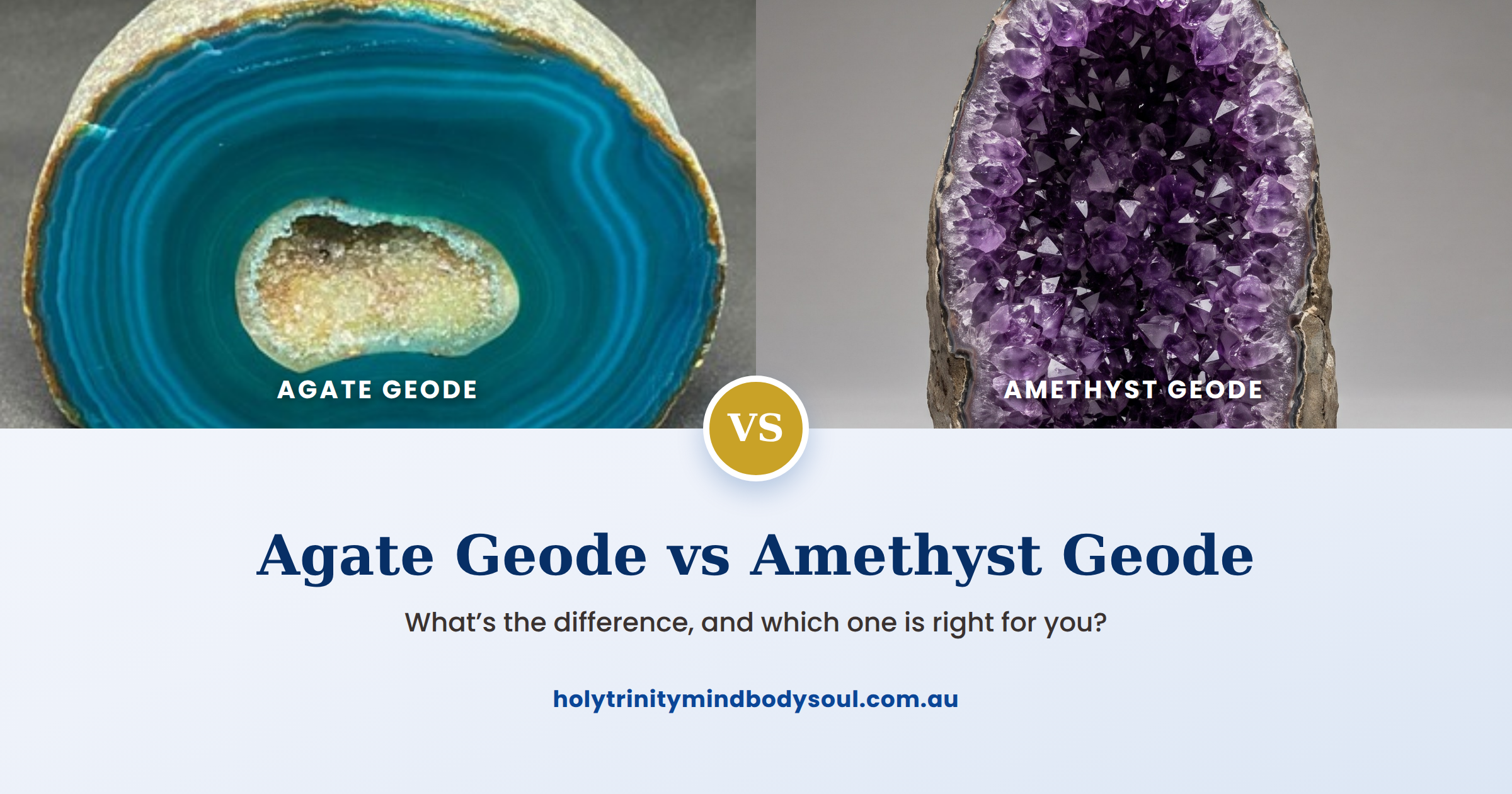
Both are sold as crystal geodes, both are genuinely natural formations, and both turn up constantly in the same search results, yet an agate geode and an amethyst geode are quite different things to actually own. One is a compact, colourful slice you can hold in one hand. The other is a large, dramatic cave built to be a room's centrepiece. Here is how to tell them apart, and how to choose between them.
What Makes a Geode a Geode
Geode describes a formation, not a specific mineral. It starts as a hollow bubble inside volcanic or sedimentary rock, often left behind by a gas pocket or a dissolved piece of earlier mineral. Over thousands of years, mineral rich groundwater seeps into that cavity and slowly deposits layer after layer of crystal on the inside wall. From the outside, a geode can look like an unremarkable lump of rock. Cut or crack it open, and it reveals whatever crystal happened to grow inside, which is where agate and amethyst geodes part ways.
How Agate and Amethyst Geodes Form Differently
Both start life the same way, as a hollow cavity in rock, but what grows inside each one is genuinely different, and that difference shapes almost everything else about the finished piece:
- Agate geodes form when silica rich water deposits agate, a banded, microcrystalline variety of chalcedony, in fine layers around the inside wall of the cavity. Rather than growing as individual pointed crystals, agate builds up as smooth, concentric rings of colour, working inward from the outer wall. Many agate geodes still leave a small open pocket at the centre, often lined with tiny sparkling crystal points, but the defining feature is the banding.
- Amethyst geodes form when the same kind of cavity instead fills with large, pointed quartz crystals coloured purple by trace iron, deep inside rock that has been under natural heat and pressure. Rather than banding inward, the crystals grow outward from the cavity wall toward the centre as long, visible points, which is why an amethyst geode's interior looks like a cave lined with jagged purple spikes rather than smooth rings.
In short, agate grows in layers and amethyst grows in points, and that single difference explains why the two finished products end up looking, and being used, so differently.
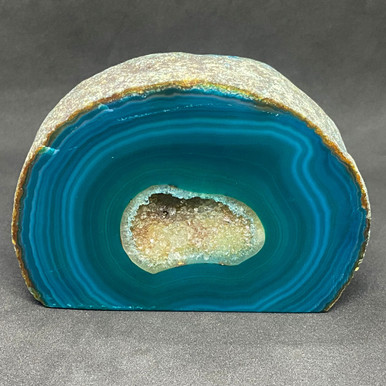
Shop Our Agate Geodes Range
Hand picked, base cut agate geodes, each one self standing and ready to display.
Shop Agate GeodesAgate Geode vs Amethyst Geode at a Glance
| Agate Geode | Amethyst Geode | |
|---|---|---|
| Look | Smooth, concentric bands of colour with a small crystal lined pocket at the centre | A hollow cave lined edge to edge with visible, pointed purple crystals |
| Typical size | Palm sized, roughly 7 to 10 centimetres, base cut to stand upright on its own | Noticeably larger, commonly 15 centimetres and well beyond, sold as a standing cave or feature piece |
| Typical price | An accessible, everyday crystal price point, our own range runs from $35 to $100 | A bigger investment as size increases, from around $150 for a small cave up to several hundred dollars or more for a large statement piece |
| Best use | A desk, shelf or bedside table piece, doubles neatly as a paperweight | A statement piece for a console table, mantle or living space, built to be noticed from across the room |
Sizing and pricing above reflect general, typical ranges rather than any one specific piece, since natural formations vary. Check the individual product listing for exact size, weight and price before buying.
Shop Our Amethyst Cave Collection
Large, hand selected amethyst geode caves for a genuine feature piece.
Shop Amethyst CaveWhich One Is Right for You?
A few simple questions make the choice easier:
- Do you want something for a desk or a shelf? An agate geode is the practical fit. It is base cut to stand upright on its own, compact enough not to crowd a work space, and doubles as a natural paperweight.
- Do you want a genuine centrepiece? An amethyst geode cave is built for exactly that. Its scale and the sheer density of visible crystal points make it a piece people notice and ask about.
- Are you working to a smaller budget, or just starting a collection? Agate geodes sit at a far more accessible price point, making them the easier starting piece.
- Do you prefer colour and pattern, or texture and sparkle? Agate's banding brings colour and rhythm to a piece. Amethyst brings texture, depth and light catching sparkle instead.
- Can’t decide? There is no rule against owning both. A small agate geode on a desk and a larger amethyst cave anchoring a shelf or console work well together rather than competing.
Frequently Asked Questions
Is an amethyst geode more valuable than an agate geode? Generally, yes, mainly because of size. Amethyst geodes are typically sold as much larger pieces, and larger natural crystal formations command a higher price regardless of type.
Can an agate geode also contain amethyst? It is possible. Some geode formations develop both banded agate around the outer wall and pointed crystal, including amethyst, further inside, though this is more the exception than the rule for the base cut agate geodes commonly sold as desk pieces.
Which is more durable, agate or amethyst? Both are hard, quartz family minerals well suited to display and everyday handling. Amethyst's crystal points are more delicate to knock or chip than agate's smooth, rounded surface, simply because of their shape.
Do agate and amethyst geodes have different meanings? Yes, broadly. Agate is traditionally associated with grounding, balance and courage, while amethyst is traditionally associated with calm, clarity and spiritual connection. See our full guides to agate geode healing properties and amethyst geode meaning and healing properties for more detail.
Can I buy both from Holy Trinity Mind Body Soul? Yes. Our agate geode range and amethyst cave collection are both available online, with fast shipping Australia wide.
Ready to choose? Explore our agate geode range or browse our amethyst cave collection to see the difference for yourself.
