
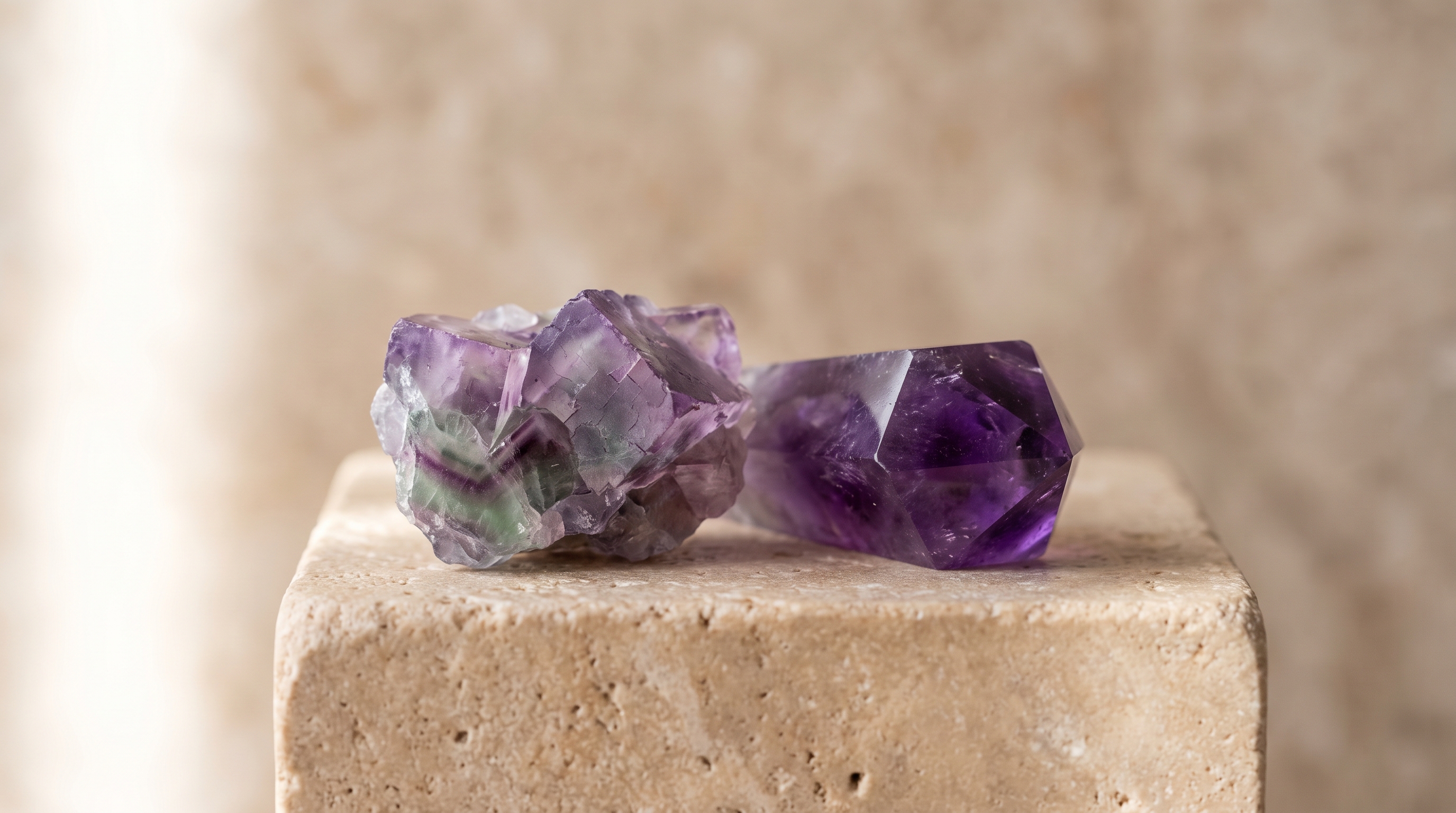
If you have ever picked up a deep purple crystal at a market stall or scrolled past one online and genuinely could not tell whether it was Fluorite or Amethyst, you are in good company. Purple Fluorite, especially in its natural cubic or octahedral form, gets mistaken for Amethyst all the time, and it is an easy mix up to make since both stones share that same rich violet colour family.
They are not the same mineral, though, and they are not traditionally used for the same thing. This guide covers how to tell them apart at a glance, what each one is generally used for, why some people keep both, and which one is the better fit for what you are actually trying to achieve.
How to Tell Purple Fluorite and Amethyst Apart at a Glance
The two most reliable differences come down to how each crystal naturally grows and how hard it is.
Crystal Shape
Fluorite most commonly forms in cubic or octahedral shapes, meaning natural pieces tend to show flat, geometric faces meeting at sharp angles, sometimes looking almost like a natural gemstone die. Amethyst, on the other hand, is a variety of quartz, and quartz grows in hexagonal columns that taper to a pointed, pyramid like termination at one end. If the piece in front of you has a single pointed tip, it is almost certainly Amethyst rather than Fluorite.
Colour and Clarity
Amethyst typically shows a single, fairly consistent violet hue running through a clear to translucent stone, sometimes with visible internal fractures or a slightly cloudy interior called "silk". Fluorite is much more likely to show banded, zoned colour within one piece, often purple sitting alongside green in clean, layered bands, the same natural colour zoning covered in our guide to spotting real versus dyed Fluorite. If you are looking at a single, evenly saturated violet stone, lean Amethyst. If you can see distinct colour zones or a second colour entirely, lean Fluorite.
Hardness
This is the most reliable test if you can safely try it on an inconspicuous edge. Amethyst, as a variety of quartz, sits at 7 on the Mohs hardness scale, hard enough that a steel blade will not scratch it at all. Fluorite sits at a much softer 4, meaning a steel blade or a shard of glass will leave a light scratch. If nothing scratches it, you are almost certainly holding Amethyst.
How It Breaks
As a variety of quartz, Amethyst breaks with a curved, shell like fracture, the same conchoidal fracture that glass shows. Fluorite instead breaks along flat, mirror smooth planes in a signature called perfect octahedral cleavage, the same trait we walk through in more detail in Is Your Fluorite Real?. A flat, angular broken edge points to Fluorite. A curved, shell like broken edge points to Amethyst.
What Each Stone Is Traditionally Used For
Beyond how they look, Fluorite and Amethyst are traditionally kept for genuinely different reasons.
Fluorite is best known as the "Genius Stone", traditionally used to support focus, mental clarity and processing information, the sort of crystal people keep on a desk during study or deep work. We cover this in full in Fluorite, the Genius Stone.
Amethyst is traditionally associated with calm, spiritual protection and better sleep, connected to the crown and third eye chakras and long used to support meditation and a settled, quiet mind rather than sharp, task focused concentration. Our own guide to cleansing, charging and using Amethyst covers its history and everyday rituals in depth.
In short, Fluorite tends to be the stone people reach for to get something done, while Amethyst tends to be the stone people reach for to wind down.
Why Some People Layer Both Together
Because Fluorite and Amethyst are traditionally used for such different moods, calm versus focus, many crystal users keep both rather than choosing one over the other. A common pairing is Amethyst nearby during meditation or before bed to settle the mind, then Fluorite on the desk once it is time to actually sit down and work, treating the two as bookends for a day rather than competitors for the same shelf space.
Which One Do You Need?
- Choose Fluorite if you are after help with study, focus, decision making or cutting through mental clutter during the day.
- Choose Amethyst if you are after calm, better sleep, spiritual protection or support for a meditation practice.
- Choose both if you want the full range, a calming stone for downtime and a clarifying stone for focused work.
Ready to focus?
Shop FluoriteReady to unwind?
Shop AmethystYou can browse the full, genuine range on our Fluorite crystal collection page and our Amethyst crystal collection page, both hand selected for genuine colour and clarity.
Frequently Asked Questions
Is purple Fluorite the same as Amethyst? No. They are different minerals. Fluorite is calcium fluoride, while Amethyst is a purple variety of quartz. They can look similar in colour, but they form differently, break differently, and sit at very different hardness levels.
Why do people confuse Fluorite and Amethyst? Mostly the colour. Purple Fluorite and Amethyst share a similar violet hue, and a natural Fluorite octahedron can look, at a glance, a little like a stubby Amethyst point, especially in a photo where scale and texture are hard to judge.
Can Fluorite and Amethyst be used together? Yes. Many people keep both, using Amethyst for calm and meditation and Fluorite for focus and study, rather than treating them as competing choices.
Which is harder, Fluorite or Amethyst? Amethyst is significantly harder. As a variety of quartz it sits at 7 on the Mohs scale, while Fluorite sits at 4, meaning Fluorite scratches far more easily and needs a little more care in daily handling.
Is Fluorite cheaper than Amethyst? Generally, yes, though it depends on the specific piece, size and form. Fluorite is typically more affordable than comparably sized natural Amethyst, which is one reason it is a popular, accessible starting point for a desk or study space.
