
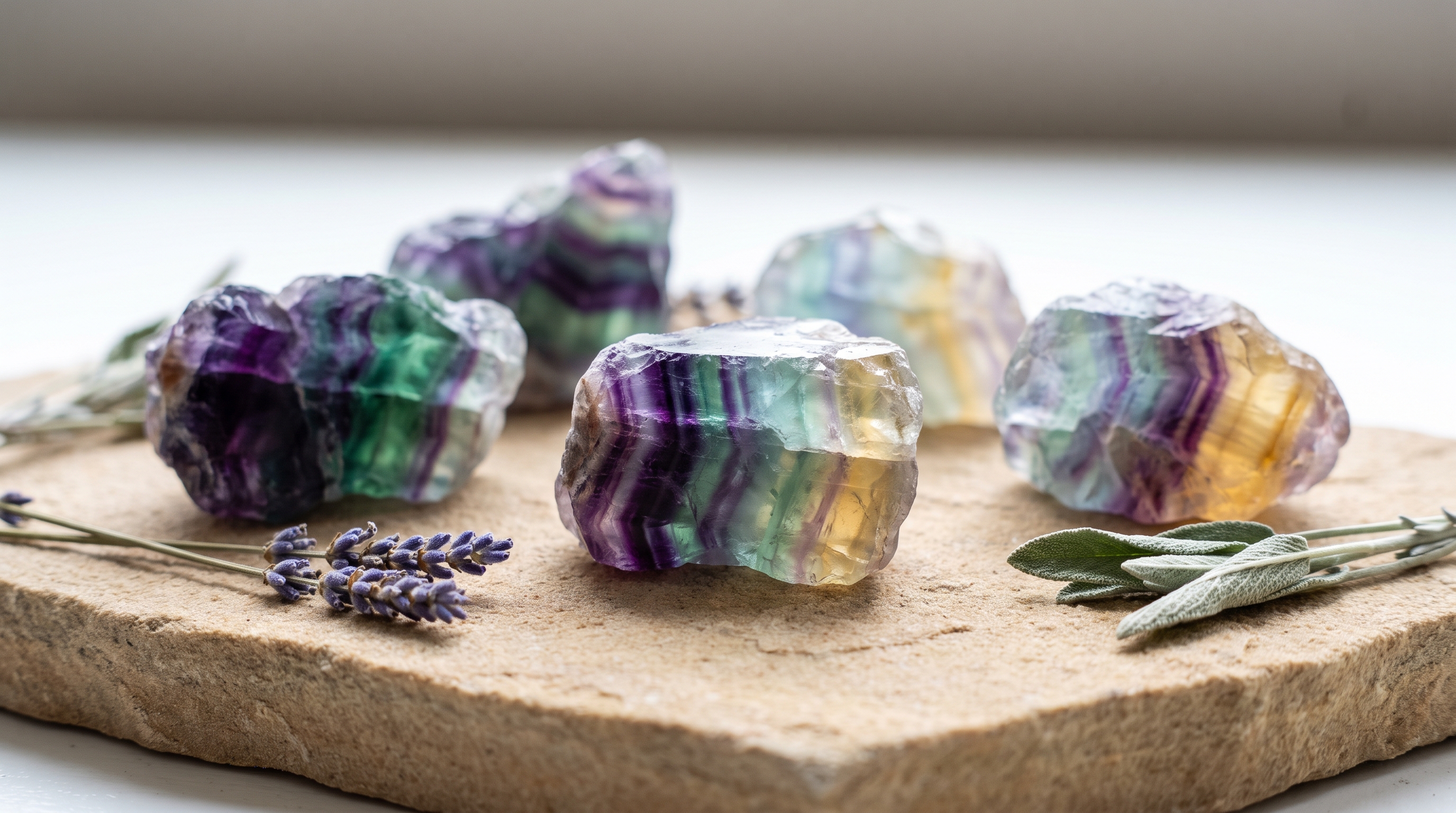
Fluorite is one of the most visually striking crystals we carry, and that is exactly why the authenticity question comes up so often. Vivid purple and green banding, a glassy sheen, and a price that is friendlier than most gemstones make Fluorite an easy stone to imitate with dyed quartz, dyed calcite, or coloured glass. If you have ever looked at a strikingly perfect, uniformly saturated piece and wondered whether the colour is a little too good to be true, this guide is for you.
Here is the reassuring part: Fluorite is one of the easier crystals in our range to verify at home, because the very thing that makes it soft and easy to work with also makes it easy to test. Below is what genuine colour banding actually looks like, the tell-tale signs of a dyed or glass imitation, two simple physical tests you can run on a piece you already own, and what "hand selected for colour and clarity" actually means for the Fluorite we stock.
What Makes Genuine Fluorite's Banding So Distinctive
Fluorite's colour comes from trace impurities and natural radiation exposure locked into the crystal as it formed, deep within the earth, over a very long time. This is why genuine banding tends to follow the crystal's actual growth structure: colour zones that sit in clean, geometric layers, often tracking the cubic or octahedral shape the mineral naturally grows in, with the transition between colours looking gradual and slightly uneven rather than perfectly crisp.
This natural process is genuinely difficult to fake convincingly, which is good news for buyers. Most imitations do not attempt to replicate the growth pattern at all. Instead, they rely on a surface treatment applied after the fact, which is exactly where the tell-tale signs below start to show.
Tell-Tale Signs of Dyed or Glass Fluorite
- Colour that pools in cracks and fractures. Dye is typically applied to the surface or drawn in through existing fissures, so it often shows up darker and more concentrated exactly where the stone has natural cracks, rather than following the crystal's growth bands. Genuine colour zoning does not care where the cracks are.
- Colour that looks painted on rather than grown in. If you can see a thin surface layer of colour sitting on top of a paler or colourless interior, most obviously at a chip or a polished edge, that is dye, not natural zoning.
- Unnaturally uniform, saturated colour with no variation. Real Fluorite almost always shows some tonal variation, streaking, or subtle patchiness across a piece. A colour that looks flawlessly even from every angle, especially in a deep, glowing purple or emerald green, is worth a second look.
- No weight or temperature the mineral should have. Glass imitations are usually lighter than genuine Fluorite for the same size, and warm up quickly and unevenly in the hand, where a real mineral specimen feels cool at first touch and warms gradually.
- Bubbles or swirl marks inside the piece. Small trapped air bubbles or a swirled, almost syrupy internal pattern are classic signs of cast glass, and something genuine Fluorite, formed as a crystalline mineral, will never show.
Two Physical Tests You Can Run at Home
You do not need a lab to check a piece of Fluorite. Two of its defining physical properties make it one of the more straightforward crystals to verify yourself.
The Hardness Test (Mohs 4)
Genuine Fluorite sits at 4 on the Mohs hardness scale, harder than a fingernail (roughly 2.5) but softer than glass and steel (roughly 5.5 and above). In practice, this gives you a clean pair of checks on an inconspicuous edge:
- A fingernail should not be able to scratch genuine Fluorite.
- A steel blade or a shard of glass should be able to leave a light scratch on genuine Fluorite.
If a piece scratches easily with just a fingernail, you are likely holding dyed gypsum, calcite, or another much softer imitation rather than Fluorite. If nothing short of quartz will scratch it at all, you may be holding dyed quartz or glass instead, since both sit well above Fluorite on the hardness scale.
The Cleavage Test
This is Fluorite's real signature. Genuine Fluorite has what mineralogists call perfect octahedral cleavage, meaning it breaks cleanly along four flat, mirror-smooth planes rather than shattering randomly. If you look closely at a broken or naturally formed edge, you should see flat, angular facets meeting at consistent angles, sometimes described as looking like the corner of a diamond.
Glass, by contrast, always breaks with a curved, shell-like fracture (what mineralogists call conchoidal fracture), never a flat plane. This single difference is one of the most reliable ways to tell genuine Fluorite from a glass imitation, and it is worth checking before you check anything else.
A Bonus Check: Fluorescence Under UV Light
Here is a fact most people do not know: the word "fluorescence" is named after Fluorite, because it was one of the first minerals observed glowing under ultraviolet light. Many genuine Fluorite specimens will glow, often blue or violet, under a UV torch or blacklight, though not every piece fluoresces equally strongly since it depends on the exact trace elements present. This will not confirm a fake on its own, since not all real Fluorite glows, but a strong, unusual glow paired with the other signs above is a fun, genuinely useful extra data point if you already own a UV torch.
Shop Genuine Fluorite


What "Hand Selected for Colour and Clarity" Actually Means Here
Our Fluorite collection page describes every piece as hand selected for colour and clarity, and it is worth explaining what that means in practice rather than leaving it as a nice sounding line. It means each Generator Point, Sphere and Pyramid is chosen individually for how its natural banding actually looks, rather than bought as an unseen bulk lot and listed sight unseen. It means we are not selling dyed or glass imitations under the Fluorite name, and it means the colour variation you see between two Generator Points on the same page, one leaning more green, another more purple, is real, natural variation rather than a batch of identically dyed stock.
That natural variation is worth embracing rather than worrying about. No two genuine Fluorite pieces will ever band in exactly the same pattern, which is part of what makes a natural specimen more interesting to own than a mass produced, artificially uniform one.
You can browse the full, genuine range on our Fluorite crystal collection page. If you are shopping for a desk piece specifically, our guide Fluorite, the Genius Stone: How to Use It for Focus, Study and Mental Clarity covers which shape suits your workspace. For Fluorite's broader colour meanings and general healing properties, start with The Healing Properties of the Colourful Fluorite Crystal.
Frequently Asked Questions
Is Fluorite real, or is most of what's sold fake? Genuine Fluorite is a common, abundant, naturally occurring mineral, so most Fluorite on the market is real. The imitations that do exist are usually dyed quartz, dyed calcite, or coloured glass sold under the Fluorite name to trade on its popularity, rather than counterfeit Fluorite itself.
How can I tell if my Fluorite is dyed? Look for colour that pools in cracks and fractures rather than following the crystal's natural growth bands, a painted-on look at chips or edges, and unnaturally uniform, flawless saturation. Genuine colour zoning is usually a little uneven and follows the stone's actual shape.
What's the easiest way to check if Fluorite is glass? Check how it breaks. Genuine Fluorite has perfect octahedral cleavage, meaning it breaks along flat, mirror-smooth planes at consistent angles. Glass always breaks with a curved, shell-like fracture, never a flat plane. Weight and warmth in the hand are useful secondary clues, since glass imitations tend to feel lighter and warm up faster than a real mineral.
Does real Fluorite scratch easily? Genuine Fluorite sits at 4 on the Mohs hardness scale. A fingernail should not scratch it, but a steel blade or a piece of glass will leave a light scratch. If a fingernail scratches your piece easily, it is likely a much softer material rather than Fluorite.
Does all Fluorite glow under UV light? Many pieces do, often blue or violet, since the word "fluorescence" is actually named after Fluorite. Not every specimen fluoresces equally strongly, so this is a fun bonus check rather than a definitive test on its own.
These are practical, physical checks based on general mineralogical information rather than a laboratory analysis. If you are ever unsure about a specific piece, our team is always happy to help before or after you buy.
