
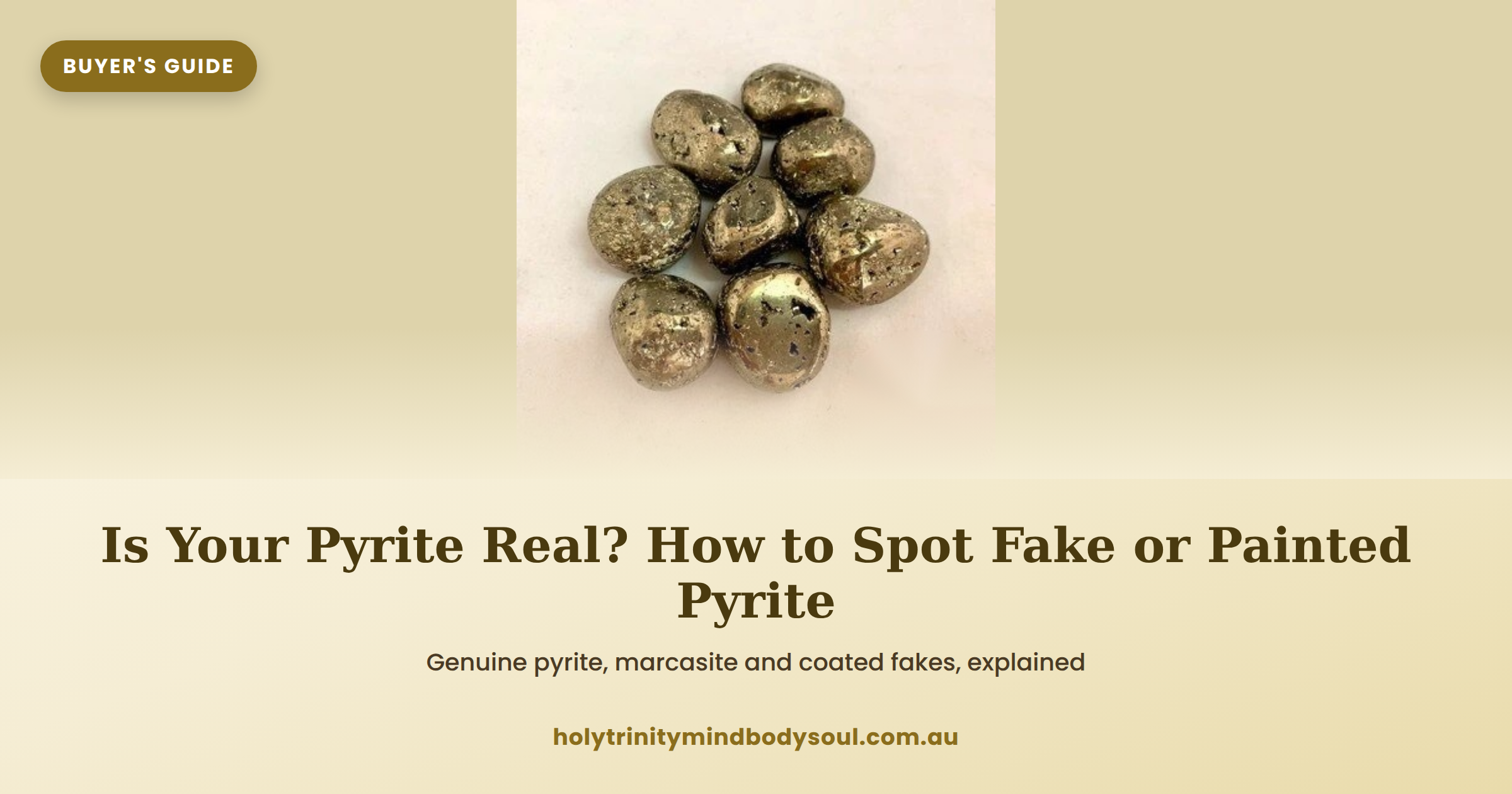
Pyrite's whole reputation is built on looking like something it is not, gold, which makes the authenticity question a natural one to ask. Between painted resin cubes sold online as "pyrite," and pyrite's own visual cousin marcasite, it is genuinely easy to end up with something other than what you paid for. If you have ever looked at a suspiciously smooth, perfectly shiny piece and wondered whether it is the real thing, this guide is for you.
The good news is that pyrite is one of the more straightforward crystals to verify yourself, because its natural crystal habit is so distinctive. Below is what genuine pyrite actually looks and feels like, the tell-tale signs of a painted or coated fake, how pyrite differs from marcasite and why that distinction matters, and two simple checks you can run on a piece you already own.
What Makes Genuine Pyrite So Distinctive
Pyrite is an iron sulphide mineral that commonly forms sharp, natural cube shapes as it crystallises, sometimes on their own and sometimes clustered together. One of its most reliable, hardest to fake features is on the flat faces of those cubes: genuine pyrite crystals very often show fine, parallel striations, tiny natural growth lines running across each face, rather than a perfectly smooth, mirror finish.
Its colour is a warm, brassy, metallic gold, with a genuine mineral lustre rather than a glossy, plasticky shine. Held in the hand, a real piece feels notably dense and heavy for its size, a small but useful clue that shows up in the checks below.
Tell-Tale Signs of Painted or Coated Pyrite
- Colour that chips, flakes or rubs off. A coated or painted fake, often a resin or plaster cast, will show its true colour underneath at any small chip, scratch or worn edge. Genuine pyrite's colour goes all the way through.
- A perfectly smooth surface with no natural striations. Moulded fakes are cast from a single smooth surface, so they lack the fine parallel growth lines genuine pyrite cubes almost always show on their faces.
- A glossy, plastic-like shine rather than a metallic lustre. Genuine pyrite has a distinctive metallic sheen. A shine that looks closer to varnish or glass, especially if it pools unevenly in corners, is a sign of a surface coating.
- Unusually light for its size. Resin and plaster fakes are noticeably lighter than genuine pyrite, which is a dense mineral. A piece that feels closer to a plastic toy than a rock is worth a second look.
- A price that feels too good to be true. Genuine natural pyrite, especially in larger cube or cluster form, is not the cheapest mineral around. A suspiciously large, perfectly formed piece for a very low price is a common sign of a cast imitation.
Pyrite vs Marcasite: What's the Difference, and Why It Matters
Marcasite is often described as pyrite's evil twin, and for good reason. The two minerals share almost the same chemical makeup, both are iron sulphide, but they form with a different internal crystal structure, which is a big part of why one holds up far better over time than the other.
Genuine pyrite typically forms in sharp, stable cube or cluster shapes and is reasonably durable when kept dry. Marcasite tends to form in more tabular, radiating or spiky clusters, and is often a paler, slightly greenish yellow compared to pyrite's warmer gold. The most important practical difference is stability. Marcasite is far more prone to a condition sometimes called "pyrite disease," where the mineral gradually reacts with moisture in the air and breaks down, developing a faint sulphurous smell, a dull white or grey powdery coating, and eventually crumbling. Genuine pyrite can be affected too if it is kept somewhere damp, but it is considerably more stable and far less likely to deteriorate this way when properly cared for.
If a piece sold as "pyrite" starts to develop a rotten egg smell, a chalky white bloom on the surface, or visible crumbling within a relatively short time, there is a good chance it was actually marcasite rather than true pyrite.

Two Simple Checks You Can Run at Home
The Weight and Hardness Test
Pick the piece up and pay attention to how heavy it feels for its size. Genuine pyrite is a dense mineral and should feel noticeably weighty in the hand, not light like resin or plastic. Next, gently try to mark an inconspicuous spot with a fingernail. Real pyrite sits at around 6 to 6.5 on the Mohs hardness scale, hard enough that a fingernail should leave no mark at all, and even a steel blade will struggle to scratch it. A piece that scratches easily under a fingernail is not genuine pyrite.
The Close Look Test
Look closely at a flat face under good light, ideally with a loupe or your phone camera zoomed in. Genuine pyrite cube faces usually show those fine, natural parallel striations mentioned above. Check an inconspicuous edge or the base of the piece too, since that is the spot most likely to reveal a chip or scratch showing a different colour underneath, the clearest possible sign of a paint or coating.
What to Look for When You Buy From Us
Every piece of pyrite in our range is genuine, naturally formed iron sulphide, never painted, coated or cast from resin. It is chosen for its natural metallic lustre and colour rather than sold sight unseen from an unverified bulk lot, so what you see reflects how each piece naturally formed.
You can browse the full, genuine range on our pyrite crystal collection page. For pyrite's full traditional meaning, healing properties and the story behind its Fool's Gold nickname, see our guide, Pyrite Meaning: Healing Properties, Chakra and Why It's Called Fool's Gold.
Frequently Asked Questions
How can I tell if my pyrite is fake? Check for colour that chips or flakes to reveal a different shade underneath, a perfectly smooth surface with no natural striations, a glossy plastic-like shine rather than a metallic lustre, and a piece that feels unusually light for its size.
What is the difference between pyrite and marcasite? Both are iron sulphide minerals, but they form with a different crystal structure. Pyrite typically forms stable cube or cluster shapes, while marcasite forms more tabular or spiky clusters and is considerably more prone to breaking down over time, sometimes developing a sulphurous smell and a chalky white coating.
Does real pyrite scratch easily? No. Genuine pyrite sits at around 6 to 6.5 on the Mohs hardness scale, hard enough that a fingernail will not scratch it and even a steel blade will struggle. A piece that scratches easily under light pressure is not genuine pyrite.
Is pyrite real gold? No. Pyrite is an iron sulphide mineral in its own right, not a form of gold. It simply shares a similar brassy colour, which is where its Fool's Gold nickname comes from. Our Pyrite Meaning guide covers how to tell the two apart in more detail.
Why does some pyrite smell or crumble over time? This is usually a sign of marcasite rather than true pyrite, or of genuine pyrite that has been stored somewhere damp for a long time. Keeping pyrite dry, and away from humid spots like a bathroom shelf, is the best way to prevent it.
Do you ship pyrite Australia wide? Yes, we ship our full pyrite range Australia wide from our online store.
These are practical, physical checks based on general mineralogical information rather than a laboratory analysis. If you are ever unsure about a specific piece, our team is always happy to help before or after you buy.
