
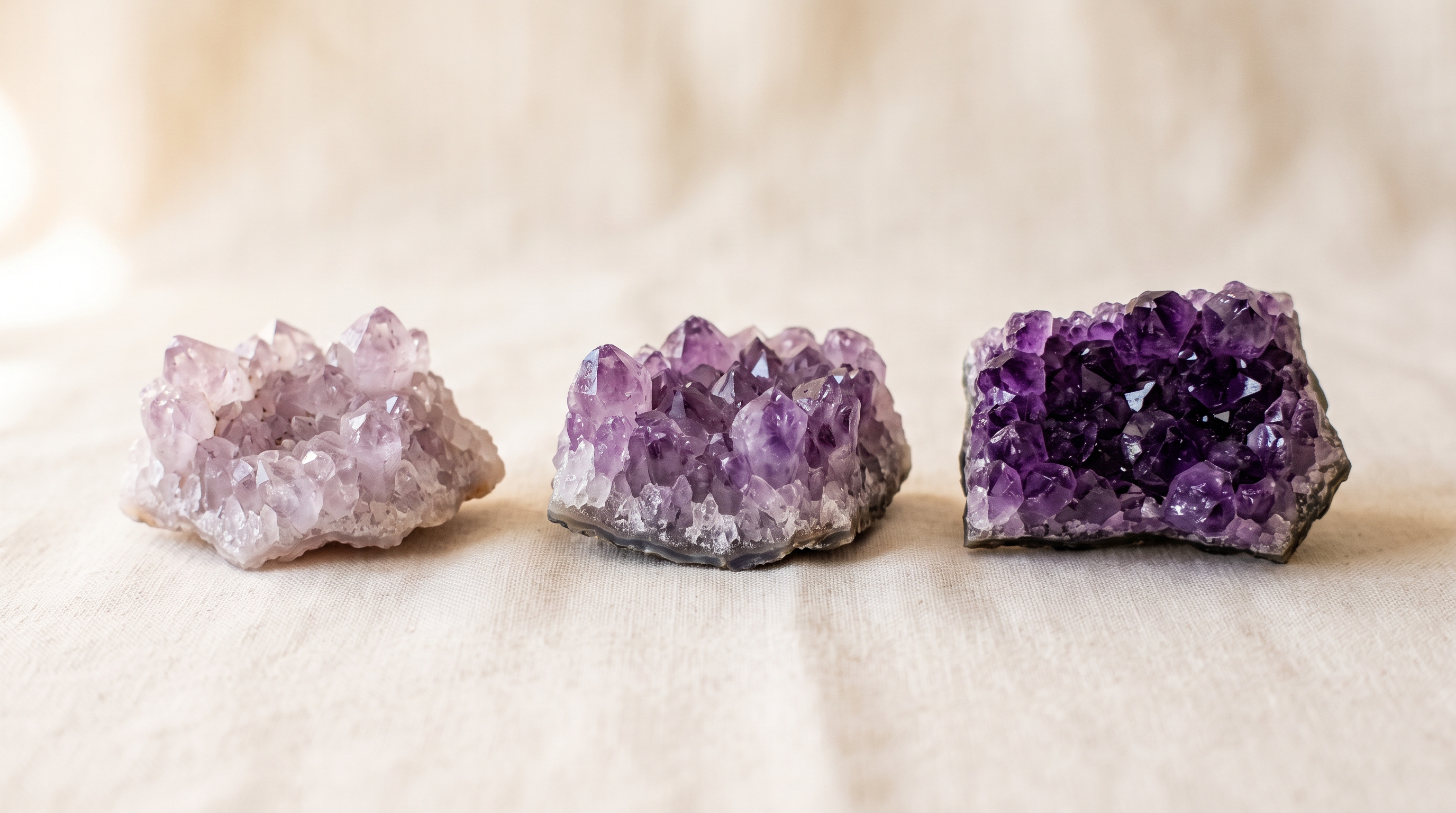
If you have browsed our amethyst range, you may have noticed some pieces described as "A Grade" and wondered exactly what that means, or how it compares to the AA and AAA labels you will see used elsewhere in the crystal market. It is a fair question, and one that rarely gets a straight answer.
This guide explains what actually determines amethyst grade, what the common A, AA and AAA labels typically mean, how origin tends to affect quality and colour, and how to read the grading already shown in our own product titles.
What Determines Amethyst Grade
Amethyst grading comes down to a handful of visual qualities, assessed by eye rather than a single fixed formula:
- Colour depth. A richer, deeper violet is generally valued more highly than a pale lilac or washed out shade.
- Saturation and evenness. How consistently the colour sits across the piece, rather than being patchy or concentrated in just one section.
- Clarity. How clear the crystal is, and how visible any internal inclusions, cloudiness or fractures are.
- Formation. For clusters and points specifically, how well formed and undamaged the natural points are.
- Cut, for faceted pieces. Faceted amethyst used in jewellery is also graded on the precision and symmetry of the cut itself.
Colour depth and clarity together do most of the work in separating a lower grade piece from a premium one, which is why two amethyst clusters of a similar size can be priced quite differently.
A Grade vs AA vs AAA: What These Terms Typically Mean
It is worth being upfront about something the wider crystal market rarely spells out: unlike diamond grading, there is no single, universally regulated authority setting these letter grades for amethyst. A, AA and AAA are a widely used trade convention rather than a certified standard, which means the exact cutoff between grades can vary slightly from one supplier to another. That said, the general pattern across the market looks like this:
- A Grade. Genuine, good quality natural amethyst with clear violet colour, generally with some visible natural variation or minor inclusions. This is a strong, honest everyday grade, not a "lesser" stone, simply not the rarest.
- AA Grade. A step up in colour depth and clarity, with fewer visible inclusions and a more even, saturated tone throughout the piece.
- AAA Grade. The rarest and most sought after tier, with deep, richly saturated colour, excellent clarity and minimal visible flaws. AAA pieces are typically priced well above lower grades because genuinely AAA quality material is far less common to source.
Because these terms are not independently regulated, the same "AAA" label can mean slightly different things from one seller to the next. The most reliable way to judge a piece is still to look closely at the actual colour, clarity and formation in front of you, alongside trusting a seller who grades consistently and honestly.
Shop Our A Grade Amethyst Clusters and Points


Does Origin Affect Amethyst Grade and Colour?
Where amethyst is mined has a real, if general, influence on its typical colour and quality, since geology varies from region to region:
- Brazil. The largest global source of amethyst, producing an especially wide range, from pale lilac through to medium violet. Because so much amethyst comes from Brazil, quality varies considerably even within Brazilian material.
- Uruguay. Well regarded for producing some of the deepest, most richly saturated violet amethyst available, often with a striking clarity that makes it a popular choice for higher grade clusters and points.
- Zambia. African amethyst, particularly from Zambia, is prized for very deep purple tones with flashes of red and blue, and is often associated with higher grade material.
- Madagascar. Another well regarded source, typically producing good clarity alongside a solid depth of colour.
Origin is a useful general guide, not a guarantee. A particular piece from any of these locations can still range in quality, which is why looking at the actual colour and clarity of the piece in front of you, alongside its stated origin, gives you the fullest picture.
How to Read Holy Trinity's Own Grading
When you see "A Grade" in one of our product titles, here is what that is telling you:
- Genuine, natural amethyst. Never dyed or artificially treated to fake a deeper colour than the stone naturally holds.
- Consistently good colour and clarity. A Grade pieces are chosen for clear violet colour and solid formation, checked by hand before they are listed.
- Natural variation is expected, not a flaw. As a genuinely natural product, some variation in shade and formation between individual pieces is normal, and is part of what makes each cluster or point one of a kind.
Shop More Graded Amethyst


You can browse our full range, including every current grade and form, on the amethyst crystal collection page.
Frequently Asked Questions
What does A Grade amethyst mean? A Grade generally describes genuine, good quality natural amethyst with clear violet colour and some natural variation, a solid honest grade rather than the rarest tier.
Is AAA amethyst always better than A grade? Typically yes in terms of colour depth and clarity, but since these grades are a trade convention rather than an independently regulated standard, it is worth judging the specific piece in front of you rather than the label alone.
Does origin guarantee amethyst quality? No. Origin is a useful general guide (Uruguay and Zambia, for example, are known for particularly deep colour), but individual pieces from any origin can still vary in quality.
Why do two similar looking amethyst clusters have different prices? Price differences usually come down to colour depth, clarity and formation, the same factors that determine grade, even when two pieces look similar in size at a glance.
Want to know what to look for to make sure a piece is genuine before you buy? Our guide, Is My Amethyst Real? A Buyer's Guide to Spotting Dyed, Synthetic and Fake Amethyst, covers that in detail. If you are still deciding which physical form suits you, our Raw vs Polished vs Tumbled Amethyst guide walks through that next.
