
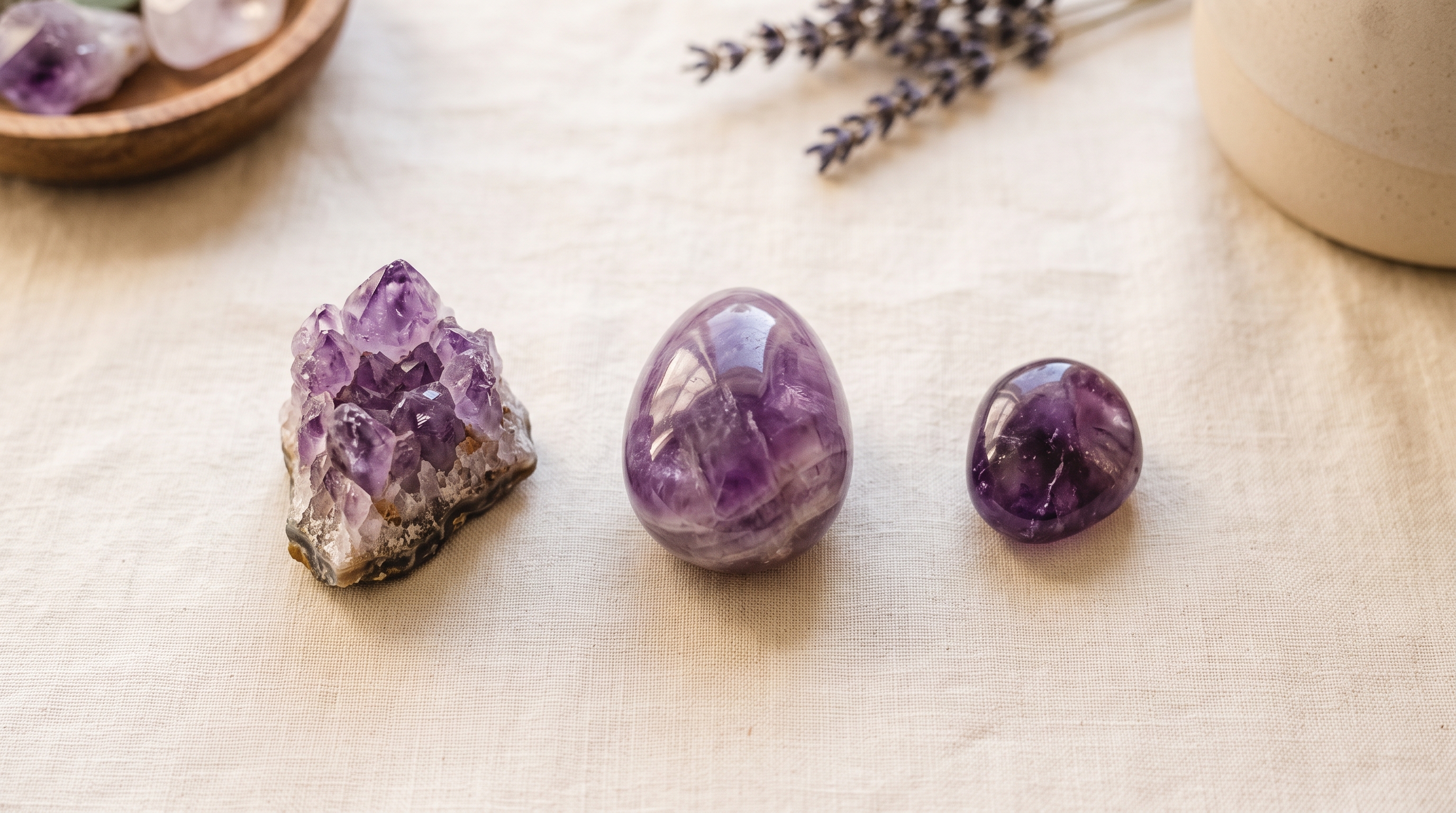
Amethyst does not come in just one shape. Browse any crystal shop for long enough and you will see the same stone sold as a rough, natural cluster, a smooth tumbled pebble, a faceted jewellery stone and everything in between. If you have ever paused on a product page wondering which form is actually right for what you want to do with it, you are not alone.
This guide walks through what "raw," "polished," "faceted" and "tumbled" actually mean, which form suits which use, and a short checklist to help you choose with confidence.
What "Raw," "Polished," "Faceted" and "Tumbled" Actually Mean
- Raw. A piece left exactly as it formed underground, uncut and unpolished. Natural points and clusters are the most common raw form of amethyst, each with its own irregular shape and natural colour variation.
- Polished. A piece that has been smoothed and given a glossy finish while largely keeping its natural shape. Seer stones and massage wands are typically polished this way.
- Tumbled. Small pieces worn smooth and rounded in a tumbling machine, using progressively finer grit until every edge is soft. This is the most affordable, pocket friendly form of amethyst.
- Faceted. Cut with flat, angled surfaces to catch and reflect light, the way a gemstone is cut for a ring or pendant. This form is used far more in fine jewellery than in raw crystal collecting, and it takes a specific cut and clarity of stone to do well.
None of these forms is more "powerful" or more genuine than another. They are simply different ways of presenting the same natural amethyst, each suited to a different purpose.
Which Form Suits Which Use?
Display pieces. Raw clusters and natural points are the classic choice for a shelf, altar or desk. Their irregular, natural formation is exactly what makes them a striking centrepiece, and a larger cluster can genuinely change the feel of a room.
Meditation. Polished seer stones and smooth tumbled stones are easiest to hold comfortably for an extended period. Their rounded shape sits naturally in the palm, without the sharp points a raw piece can have.
Carrying with you. Small tumbled stones are the practical choice here. They slip easily into a pocket or bag, are hard to damage, and are the most affordable way to keep amethyst close throughout the day.
Crystal grids. Smaller points and tumbled stones both work well, since a grid usually relies on several smaller pieces arranged together rather than one large centrepiece.
Self massage and everyday tools. Polished massage wands and worry stones are shaped specifically for holding and gentle use, unlike a raw or faceted piece, which is not designed to be handled this way.
Jewellery. Faceted amethyst is what you will typically see set in rings, pendants and earrings, chosen for its cut and clarity. Polished and tumbled pieces are also used in more casual jewellery, such as beaded bracelets.
Shop Raw and Natural Amethyst


A Short Buying Checklist by Intended Use
- Want a statement piece for your home? Choose a raw cluster or a larger natural point.
- Want something to hold during meditation? Choose a polished seer stone or a smooth tumbled stone.
- Want something to carry every day? Choose a small tumbled stone.
- Building a crystal grid? Choose a few smaller points or tumbled stones rather than one large piece.
- Want a self massage tool? Choose a polished massage wand or worry stone, shaped specifically for holding.
- Want to wear it? Look for faceted amethyst in fine jewellery, or polished and tumbled pieces in more casual jewellery.
Shop Polished and Tumbled Amethyst


Whichever form suits you, you can browse the full amethyst crystal collection to compare clusters, points, tumbled stones, wands and jewellery side by side. Every piece is genuine, natural amethyst, checked by hand before it ships, so the only decision left is which form suits how you plan to use it.
Frequently Asked Questions
Is raw amethyst more powerful than tumbled amethyst? No. Raw, polished, tumbled and faceted amethyst are all the same natural quartz, simply presented differently. Choose based on how you plan to use the piece rather than the form itself.
What is the difference between a tumbled stone and a polished stone? Tumbled stones are smoothed in a tumbling machine, giving them a rounded, pebble like shape. Polished pieces such as seer stones and wands are shaped and finished individually, often keeping more of their original form.
Which form of amethyst is best for beginners? A small tumbled stone is usually the easiest and most affordable starting point, followed by a natural point or small cluster if you want a display piece as well.
Can amethyst be faceted like a diamond? Yes, though it takes a stone with good clarity to cut well. Faceted amethyst is most commonly seen in fine jewellery rather than in raw crystal collecting.
Do you sell faceted amethyst? Our range currently focuses on raw, polished and tumbled forms, including clusters, points, tumbled stones, wands and worry stones. Browse the amethyst collection page to see what is currently in stock.
Want to make sure the piece you have chosen is genuine before you buy? Our guide, Is My Amethyst Real? A Buyer's Guide to Spotting Dyed, Synthetic and Fake Amethyst, walks through what to look for. Once you have chosen your piece, our Guide to Cleansing, Charging and Using Amethyst Crystals covers looking after it, and our Amethyst and the Chakras: A Crown, Third Eye and Zodiac Guide looks at its chakra and zodiac connections.
