
Bright, perfectly even colour is usually treated as a warning sign when you are checking a crystal's authenticity. Agate is a genuine exception to that rule, and it is an important one to understand before you buy. This guide explains why, and gives you the tools to tell genuine agate, whether natural or dyed, from an actual fake.
For general advice that applies across crystals more broadly, see our earlier post, How to Tell If Your Crystal Is the Real Deal or a Fake. This guide picks up where that one leaves off, specifically for agate.
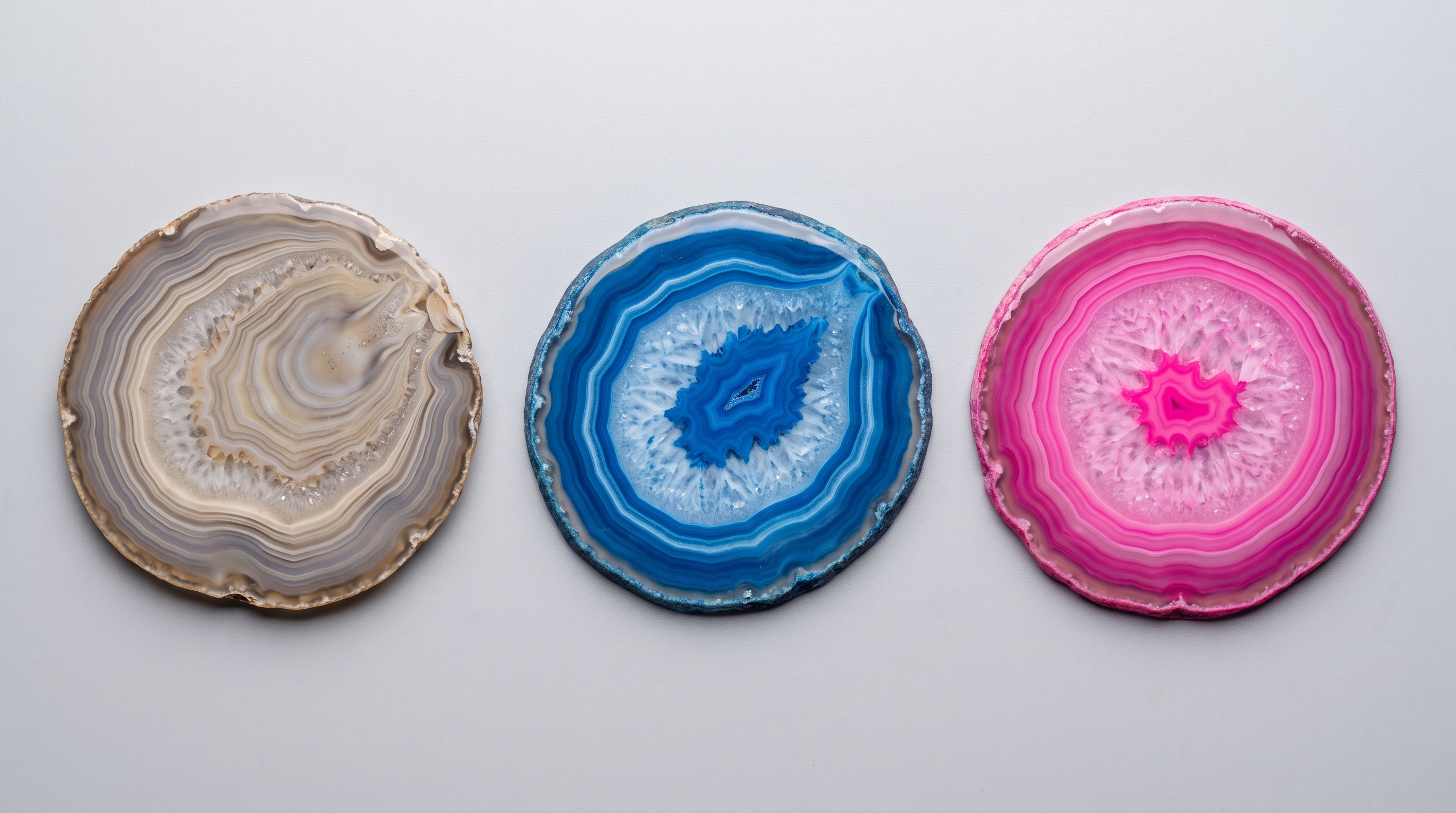
Why Agate Takes Dye So Well
Agate is a microcrystalline form of quartz, meaning it is made up of countless tiny crystal fibres packed together in bands, rather than one large, solid crystal structure. Those bands vary slightly in density and porosity from layer to layer, which is exactly what allows dye to soak in evenly and permanently along the stone's natural banding.
This is not a modern shortcut. Colour enhancing agate has been practiced for centuries, most famously in Idar-Oberstein, Germany, where artisans developed sugar and acid treatments to bring out or deepen agate's banding as early as the 1800s. Long before synthetic dyes existed, this was already standard practice in the gemstone trade. The reason it is so common with agate specifically, and much less common with denser, more uniform crystals like quartz points or amethyst clusters, comes down to that same banded, porous structure.
Natural vs Colour Enhanced Agate: Both Are Genuine Stone
This is the key distinction the generic advice on spotting fakes misses. There are two honest categories of real agate, and neither one is fake:
- Natural agate. Left in its untreated state, showing soft greys, browns, creams and earthy neutrals, exactly as it formed underground.
- Colour enhanced agate. The same natural stone, with dye added to bring out or deepen colour along its existing bands. This is how blue, purple and pink agate are typically achieved, since these vivid, even tones rarely, if ever, occur naturally at this saturation.
In both cases, the mineral underneath is one hundred percent genuine agate, formed the same way over thousands of years. Colour enhancement changes the tone on top of the stone, not the stone itself. This is different from a fake, which is not agate at all, just something made or sold to look like it.
How to Spot an Actual Fake
A genuine, colour enhanced agate is not a fake. Glass, resin, plastic, or a cheaper stone dyed and sold under agate's name is. A few checks help tell the difference:
- Air bubbles. Glass and resin often trap tiny air bubbles during moulding. Genuine agate, being a natural mineral, never contains bubbles.
- Banding that looks too perfect. Natural agate banding is irregular and organic, with bands that vary in width and sometimes break or shift. Glass imitations often show unnaturally smooth, swirling or perfectly repeating patterns.
- Weight and feel. Agate is a dense stone and feels noticeably heavier than a same sized piece of glass or resin. Genuine stone also feels cool to the touch initially and warms slowly, where plastic tends to feel closer to room temperature straight away.
- Surface texture. A polished agate face is smooth but not perfectly uniform, and the raw outer edge, where left unpolished, will show a genuinely crystalline, slightly rough texture rather than a moulded finish.
- Price. A price that seems too low for the size and finish on offer is one of the most reliable warning signs, regardless of what the listing claims.
- Seller transparency. A seller who is upfront about which pieces are colour enhanced and which are natural is a good sign in itself. Reluctance to answer the question directly is not.
How We Disclose Colour Treatment
Every colour in our agate crystal bookends range is genuine, natural agate. Natural agate bookends are left untreated, while blue, purple and pink are colour enhanced to achieve their vivid, even tone, and this is stated clearly on each product rather than left for you to guess. If you would like more detail on any specific piece before you buy, our category page FAQ covers this question directly, and our team is always happy to answer it by email or phone as well.
Frequently Asked Questions
Is dyed agate real agate? Yes. Dyeing is a colour treatment applied to genuine, natural agate. It does not change what the mineral is, only its surface tone.
Why is blue, purple or pink agate never sold as fully natural? These vivid, even tones are extremely rare in undyed agate. Reputable sellers disclose colour enhancement rather than imply these tones occur naturally at this saturation.
How can I tell if agate is fake rather than just dyed? Fake agate is usually glass, resin or plastic. Check for air bubbles, unnaturally perfect banding, lighter weight, and a price that seems too good to be true. Genuine agate, dyed or natural, will not have any of these issues.
Does colour enhancement affect agate's durability? No. The stone underneath is the same durable, natural agate either way. Colour enhancement is a surface level treatment and does not weaken the mineral.
Will the dye fade over time? With reasonable care, such as keeping pieces out of constant direct sunlight, colour enhanced agate holds its tone well. Our care guide covers this in more detail.
Ready to shop with confidence? Explore our full agate crystal bookends range, every piece genuine, with colour treatment always disclosed.
